
You’ve probably seen it all over the internet: “Get up to $2,000 back on your heat pump with the federal tax credit!” Maybe a neighbor in Taunton or Raynham claimed it last year. Maybe you bookmarked an article about it and planned to upgrade “when the time was right.”
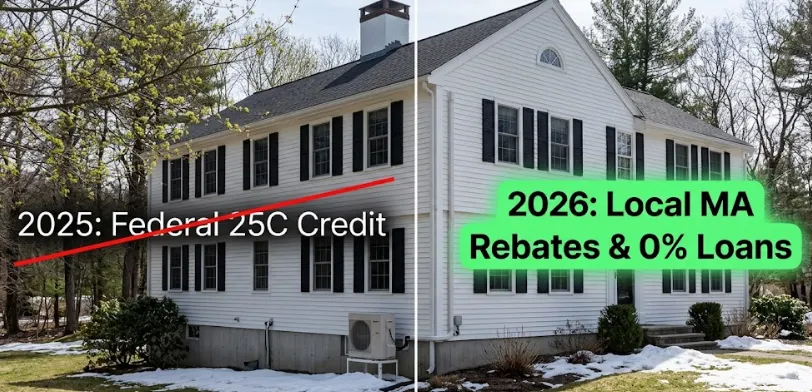
Here’s the truth, and we’re not going to dance around it. The federal heat pump tax credit 2026 question has a clear answer: no, it’s gone. The credit known as 25C expired on December 31, 2025. If your heat pump or ductless mini split is installed in 2026, there is no federal tax credit for it.
But before you close this tab and shelve your project, keep reading. Massachusetts homeowners still have some of the strongest heat pump incentives in the country. Depending on where you live and how you heat your home, you could still cut thousands of dollars off your installation. And if you live in Taunton, Berkley, or Raynham, the rules work differently than most websites tell you. We’ll cover that too, because that’s our backyard.
What Was the Federal Heat Pump Tax Credit, and What Happened to It?
The 25C credit Explained
The Energy Efficient Home Improvement Credit, called Section 25C by the IRS, let homeowners claim 30% of the cost of qualifying energy upgrades on their federal taxes. For heat pumps, including ductless mini splits, the credit was capped at $2,000 per year. Other upgrades like insulation and efficient doors fell under a combined yearly cap of $3,200.
It wasn’t a rebate or a check in the mail. It reduced the federal income tax you owed, dollar for dollar, when you filed your return.
Why it ended early
The credit was originally written to run through 2032. Then federal law changed in July 2025, and the expiration date moved up. A lot. Under current IRS guidance, the credit only applies to qualifying equipment placed in service on or before December 31, 2025.
So a heat pump installed on December 30, 2025 could earn the credit. The same system installed a week later cannot. That’s the line, and it has nothing to do with how efficient your new system is. As of mid-2026, no replacement federal credit has been passed.
You can confirm the current status anytime on the IRS Energy Efficient Home Improvement Credit page. Tax rules can change, so the IRS site is always the final word.

Installed in 2025? You may still have a claim
Here’s a detail a lot of articles miss. If your heat pump was up and running by December 31, 2025, you claim the credit on your 2025 tax return, the one due in spring 2026. The expiration date is about when the equipment was installed, not when you file.
If you installed in 2025 and forgot to claim the credit, talk to your tax preparer about whether an amended return makes sense. We’re heat pump people, not tax people, so we won’t pretend to give filing advice. But don’t assume that money is lost without asking.
What the Expired Credit Means for Your 2026 Budget
Let’s be straight about the math. For a typical whole-home ductless project, the 25C credit was worth up to $2,000. That money is off the table for 2026 installs, and pretending otherwise would be doing you a disservice.
Some HVAC websites haven’t updated their pages and still advertise the federal credit. If a contractor promises you a 2026 federal tax credit for a standard air-source heat pump, ask them to show you the IRS page that says so. They can’t, because it doesn’t exist.
What hasn’t changed is the reason heat pumps took off in Massachusetts in the first place. Oil and propane prices still sting. Window units still rattle through humid South Shore summers. And cold-climate heat pump technology still heats homes through New England winters at a fraction of the running cost of electric baseboard. The federal credit made the upgrade cheaper. It was never the reason the upgrade made sense.
And here’s the part that should genuinely change your math: Massachusetts never relied on the federal credit. The biggest money was always at the state and utility level. That money is still here.
The Good News: Massachusetts Still Pays You to Switch
Mass Save whole-home heat pump rebates
If your electric utility is Eversource, National Grid, Cape Light Compact, or Unitil, you’re a Mass Save customer. For 2026, Mass Save offers a whole-home air-source heat pump rebate of $2,650 per ton, capped at $8,500 per home.
“Whole-home” means the heat pump system becomes your main heat source, replacing oil, propane, natural gas, or electric resistance heating. For most of the fuel conversions we install around Bristol County, this is the rebate that applies, and it’s the big one.
One honest note: this rebate was higher in 2025, when it ran $3,000 per ton up to $10,000. The state trimmed it for 2026. We’d rather tell you that than let you find an old blog post quoting the bigger number and feel misled at quote time.
Partial-home rebates for additions, sunrooms, and problem rooms
Not every project is a whole-home conversion. Finishing a basement? Adding a mini split to a converted attic or a garage gym? Mass Save’s partial-home rebate pays $1,125 per ton, also capped at $8,500, when the heat pump supplements your existing heating.
There’s also a basic tier of $250 per ton, capped at $2,500, for systems that don’t meet the higher requirements. The tiers have different rules about equipment, sizing, and what you’re replacing, which is exactly the kind of fine print we walk through with you before you sign anything.
Bonus money most homeowners never hear about
Two add-ons can stack another $1,000 onto a qualifying partial-home project:
A $500 sizing bonus when the system is sized with a proper Manual J load calculation. That’s an engineering method that matches the system to your home’s actual heating needs instead of guessing by square footage.
A $500 weatherization bonus when you complete recommended insulation and air sealing alongside the project. Better insulation also means a smaller, cheaper system can do the job, so this one pays you twice.
Enhanced rebates for income-eligible households
If your household income falls under the program’s limits, Mass Save offers enhanced rebates that can reach $16,000, and the lowest-income households may qualify for a heat pump system at no cost through turnkey services. If money has been the thing holding you back, ask about this before you assume you can’t afford the switch.
The 0% HEAT Loan
On top of rebates, the Mass Save HEAT Loan lets qualifying customers finance up to $25,000 at 0% interest, with terms up to 7 years. Zero percent means every dollar you pay goes to the project, not to a bank. Combine the rebate and the loan, and many families convert from oil with little or no money down and a monthly payment that’s partly offset by lower fuel bills.
All current program amounts apply for the current program year and can change. Always confirm the latest figures at masssave.com, or just run your numbers through our rebate calculator and we’ll check them against the live program rules.

2025 vs. 2026: What Changed at a Glance
| Incentive | 2025 | 2026 |
|---|---|---|
| Federal 25C tax credit (heat pumps) | 30% of cost, up to $2,000 | Expired. $0 |
| Mass Save whole-home rebate | $3,000/ton, up to $10,000 | $2,650/ton, up to $8,500 |
| Mass Save partial-home rebate | $1,250/ton, up to $10,000 | $1,125/ton, up to $8,500 |
| Mass Save basic rebate | $250/ton, up to $2,500 | $250/ton, up to $2,500 |
| Sizing + weatherization bonuses | $500 + $500 | $500 + $500 |
| Income-eligible enhanced rebate | Up to $16,000 or no-cost | Up to $16,000 or no-cost |
| HEAT Loan | 0% up to $25,000 | 0% up to $25,000 |
| R-410A refrigerant systems | Eligible | No longer eligible for rebates |
Figures reflect the current program year and standard residential offers. Confirm current amounts with Mass Save or your utility before budgeting.
Wait, Does Mass Save Even Apply to You?
Here’s the part almost no rebate article covers, and it matters a lot if you live near our warehouse on West Britannia Street.
Mass Save is funded by the state’s investor-owned utilities. But about 50 Massachusetts communities get their electricity from municipal light plants instead, and those towns are not part of Mass Save’s electric programs. Taunton, Berkley, and Raynham are served by the Taunton Municipal Lighting Plant (TMLP). Several other towns in our service area, including Mansfield, Middleborough, North Attleborough, and Braintree, also run their own municipal utilities.

So if you live in Taunton and you’ve been reading about Mass Save heat pump rebates, here’s what you actually need to know:
TMLP runs its own program
Through TMLP Saves, TMLP customers can get no-cost home energy assessments, heat pump rebates for homes heating with oil, propane, or electric resistance, and a 0% loan of up to $25,000 with terms up to 7 years. The structure looks a lot like Mass Save, but the amounts and rules are TMLP’s own, so don’t budget off Mass Save numbers.
Heating with natural gas in TMLP territory? You flip back to Mass Save
Because the gas utility is a Mass Save sponsor, TMLP customers replacing a natural gas heating system generally go through Mass Save for their heat pump rebate, not TMLP. Confusing? A little. That’s why we check your utility and your heating fuel before we quote anything.
Other municipal towns have their own rules
Each municipal light plant sets its own rebates. If you’re in Mansfield or Middleborough, your program won’t match your cousin’s in Norton, who’s on National Grid and gets full Mass Save.
This is exactly why “just Google the rebate” fails so many homeowners around here. The right answer depends on your street, your utility, and your fuel. We sort that out in the first conversation, free, before you’ve spent a dime.
New for 2026: The Refrigerant Rule That Can Quietly Kill Your Rebate
One more 2026 change deserves its own warning label. Starting January 1, 2026, Mass Save removed all heat pump systems that use R-410A refrigerant from its Qualified Product List. To earn a rebate, your new system must use a newer, lower-impact refrigerant such as R-32 or R-454B, carry ENERGY STAR® Cold Climate certification, and appear on the qualified list.
Why should you care about refrigerant chemistry? Because some contractors and online sellers are still moving older R-410A inventory, sometimes at tempting discounts. Install one of those systems in 2026 and you could lose your entire rebate. An $8,500 mistake hiding inside a “great deal.”
When we quote your project, we quote equipment that meets the current program requirements, and we put the model numbers in writing so you can verify them on the qualified list yourself. No surprises at rebate time.

Should You Wait for a Better Deal? Probably Not, and Here’s the Honest Reasoning
We’re not going to pressure you with a fake countdown clock. But the trend line is real and worth understanding.
In 2025, a whole-home conversion could stack a $10,000 state rebate with a $2,000 federal credit. In 2026, the federal credit is gone and the state cap dropped to $8,500. Massachusetts designed these rebates to step down over time as heat pumps become standard equipment. Nobody can promise what 2027 looks like, but the direction so far has been down, not up.
Meanwhile, every winter you wait is another season of oil deliveries. Many of our Bristol County customers switching from oil see meaningful drops in their heating costs, and insulation quality is the biggest factor in how big that drop is. That’s also why the weatherization bonus exists: the state wants you to seal up the house and right-size the system at the same time.
Our take, plainly: the best incentive year was last year. The second best is this one. Waiting for a better deal has cost Massachusetts homeowners money two years running.
“I’d rather lose a sale than have a neighbor find out at tax time that a credit they were promised doesn’t exist. The federal credit is gone. The Massachusetts money is real, it’s substantial, and my job is making sure you get every dollar of it that your address qualifies for.”
— Dave Peachey, Owner, Peach Heat and Cool
How We Turn Heat Pump Rebate Chaos Into a Checklist
Reading program rules is our job so it doesn’t have to be yours. Here’s what our rebate concierge process looks like for every heat pump installation and ductless mini split installation we do:
First, we identify your actual programs
Utility, town, and heating fuel determine whether you’re a Mass Save, TMLP, or other municipal program customer. We’ve installed across our service area long enough to know which streets fall where.
Second, we quote only qualifying equipment
Every system we propose is checked against the current qualified product list and refrigerant rules, with documentation you can verify.
Third, we size it to earn the bonuses
Proper load calculations aren’t just rebate paperwork. A right-sized system runs quieter, lasts longer, and keeps rooms even. The bonus money is a nice side effect of doing the job correctly.
Fourth, we handle the filing
Rebate applications have deadlines and documentation requirements, and a missed form is a missed check. We manage the paperwork through approval.
And after the install, our system servicing for Peach clients keeps the equipment performing the way the rebate program and your warranty expect it to.
Don’t Mourn the Tax Credit. Claim What’s Still Yours.
The federal heat pump tax credit had a good run, and it’s over. What’s left in Massachusetts is still thousands of dollars in real, claimable money, but only for homeowners who know which program their address belongs to and which equipment qualifies under the 2026 rules.
That’s a 15-minute conversation with us. Tell us your town, your utility, and how you heat your home today, and we’ll tell you exactly what you qualify for, in writing, with no pressure attached.
Get your free rebate breakdown or try the rebate calculator and see your numbers in under a minute.